
Author: M. Amin Zaim, Advisor at Asatu Research & Insights
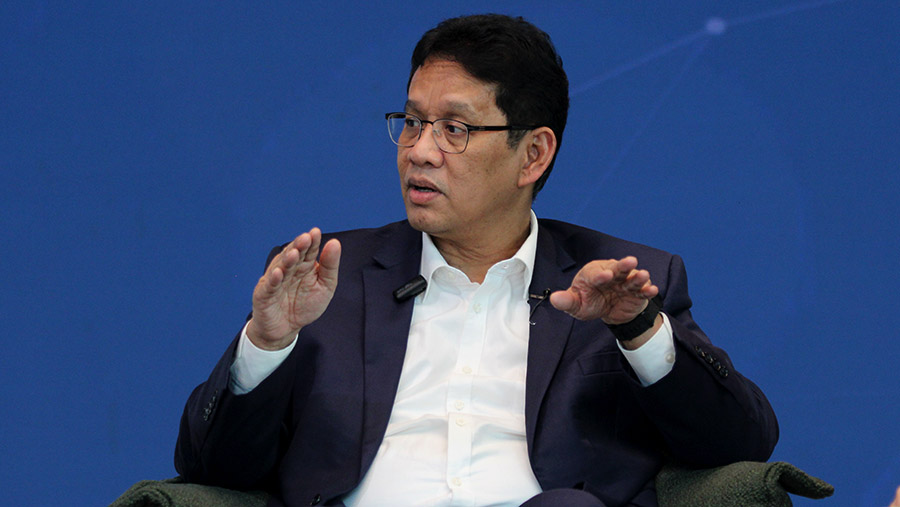
Picture: Bloomberg Technoz
Purbaya Yudhi Sadewa (Sadewa), some call him as “cowboy” minister. Many of his blunt statements went viral, posited him at the top of public mind. Some people got irritated, but many of them positively reacted. Smiling market and Rupiah rebound are framed by some observers as Purbaya Effect. However, it is too early to fairly judge his performance. In this beginning of his tenure, it is more interesting to witness his movement through the shoulder of giants (i.e., theory).
This article discusses Sadewa’s phenomena through the lens of Performativity Theory. In short, Performativity explains the phenomenon of truth construction by actions, statements, rituals, or theories themselves. They do not only describe reality. They actively create the reality.
Sadewa’s move
Sadewa was appointed to replace Sri Mulyani Indrawati, the long standing orchestrator of Indonesian economic management for years across multiple administrations, after the mass protest in September 2025. Under pessimistic market conditions, when people were afraid of economic turmoil, Sadewa tried to flip the game. After the mass protest, people could fear further state budget cut downs in the name of “efficiency”, one Prabowo policy which many argue is one of the triggers behind the September 2025 unrest. In contrast, investors might fear that Prabowo would loosen fiscal or monetary discipline in order to calm the streets with more popular programs. It was very difficult to be optimistic about the country’s future at that moment.
Sadewa needed only a few hours after his appointment to make a shocking statement related to the motive behind that mass protest. He suggested that the demonstrations were mainly driven by people under prolonged economic pressure, in simple terms, “maybe they are hungry, once their stomach is fed the protest will stop”. Some saw the statement as a shocking lack of empathy from an elite figure. But it can also be read as a performance of confidence: “do not worry, this is not that serious, and we know how to manage this situation”. He did not stop there. He claimed that the Indonesian economy was getting worse not because the fundamentals were truly broken, but because of fiscal and monetary mismanagement by previous policy. He said that the economy would accelerate once the policy mix was corrected.
Sadewa’s message was clear. The downside in the economy was caused by a “dry” financial system. “We need more cash in the system.” Then he flooded the system with money. Roughly IDR 200 trillion of idle government funds that had been parked at the central bank were moved into state owned commercial banks with instructions to lend it to the real sector, not to park it in bonds. Within the first couple of weeks, tens of trillions of rupiah in new credit had already gone out, with one large state bank publicly saying that about IDR 40 trillion had been pushed into loans. Some people worried about inflation because of that cash injection. Sadewa anticipated this criticism. His message was bold: this is not additional spending, this is not printing money, this is only moving state money from one pocket (the central bank) to another pocket (commercial banks) so it actually circulates.
“Economy is economic”
Through his statements, Sadewa was clearly performing a theatre of truth formation. His speech represented the government’s confidence to handle the situation and aimed to keep capital circulating domestically. By injecting money into the system, Sadewa signalled to market players that economic activity would be pushed to move faster by reducing the cost of funds. More liquidity means cheaper money, which means borrowing becomes easier, which finally means economic activity should become more massive. Under uncertainty, market players could interpret Sadewa’s statement as the most probable future state of the economy. Whether Sadewa’s message truly represents the hard truth or not, it is another business. When all players believe the economy will improve and act as if the economy will actually improve, then the economy can actually improve. Aligned with Callon (1998) and MacKenzie (2006), Sadewa was practicing a classic performativity move: economic talk is not neutral talk, it is part of how the economy itself is produced.
Sadewa understood that his narrative was not the only narrative in the air. On top of his optimism of six to seven percent growth in the near future, the IMF (International Monetary Fund) claimed that the Indonesian economy could slow in 2025 to around 4.7 percent annual growth. This claim directly confronted Sadewa’s story about Indonesia’s future and could interrupt the willingness of economic actors to move toward his promised acceleration. Sadewa spoke up. He rejected the IMF view in public, told people not to trust the IMF, and presented his own supporting data. His older provocative line “do not trust the IMF, they are not very smart” went viral.
Sadewa also understood that performativity is not a one-night show. The narrative must be maintained. Butler (1993) explains that the construction of truth through performativity is a continuous, repetitive process, not something that is simply expressed once. Counter narratives must be handled. Potential unfavourable interpretations must be watched closely. It will be hard to win the game if the momentum reverses.
We have many other examples of how Sadewa tried to enact reality through his statements and actions. He personally phoned the official tax hotline pretending to be a taxpayer, a symbolic act of tidying up his staff in real time instead of waiting for slow formal procedures. He also removed tax officers accused of misconduct, signalling a kind of control without needing to redesign the entire bureaucracy first: “I am fixing the system now, other troublemakers will be punished the same”. Taken together, these actions consistently tell the public, especially taxpayers: “your money is in good hands. I am standing with you. You can pay tax calmly”.
From the lens of Performativity Theory, we can…
Performativity does not justify dishonesty about reality. Performativity claims that narrative is not a neutral description of reality. Instead, narrative actively shapes reality. Narrative is not just propaganda to make people believe something that does not exist. Instead, narrative is a coordination tool that directs the environment, in this case economic actors, to behave as the narrative expects.
As economic actors, either investors, consumers, producers, or any other players, one key takeaway is to keep an eye on whether the narrative still works or not, and whether it is getting stronger or weaker. Narrative is fragile. Sadewa needs to maintain that his claims remain logical and do not clash with conditions that people can clearly see. This understanding can guide your individual action. You can choose to be an active player who reinforces or weakens the narrative. You can also choose to be a more passive player who monitors the strength of the narrative and makes timing decisions based on it. Which course of action you take depends on your own position.
Narrative can be a powerful tool, and Sadewa is only at the beginning of using it. Many people underestimate this mechanism and still see “reality” as an independent and separate thing. Some call his move social engineering. But does the fact that something is engineered automatically mean it is not natural? Probably not. Maybe we should ask a different question: which part of our political economy is not shaped by social engineering practices? If you can find that part, tell me if it truly exists.
References
Butler, J. (1993). Bodies that matter: On the discursive limits of “sex.” Taylor and Francis.
Callon, M. (1998). Introduction: The Embeddedness of Economic Markets in Economics. The Sociological Review. https://doi.org/10.1111/j.1467-954X.1998.tb03468.x
MacKenzie, D. A. (2006). An engine, not a camera: How financial models shape markets. The MIT press.